

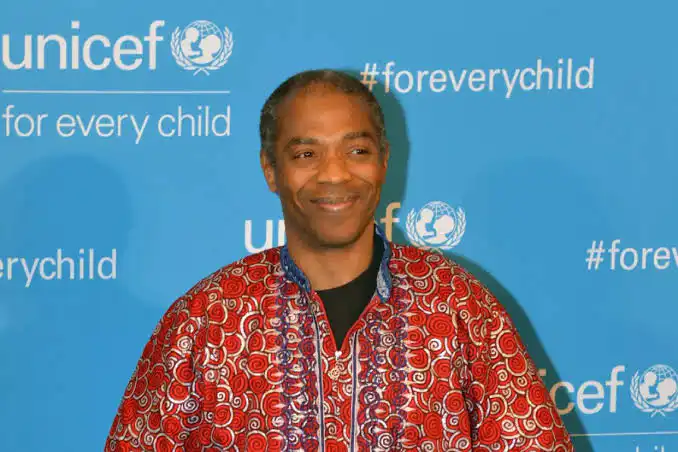
Afrobeat superstar Femi Kuti has said he feels irritated whenever people associate him with the late former President Muhammadu Buhari, describing such claims as false and deeply hurtful.
Femi made the remarks during an appearance on Arise Television, while reacting to the posthumous Grammy Lifetime Achievement Award conferred on his father, Afrobeat pioneer Fela Anikulapo Kuti.
According to him, the Grammy recognition is a powerful global acknowledgment of a man who dedicated his life to confronting dictatorship, corruption and injustice in Nigeria and across Africa.
“Everybody is very happy. We’re excited,” Femi said. “I’m in Los Angeles right now, and it’s very hard to explain, unless you were alive in the 1970s, what my father did, fighting dictatorship in Nigeria at that time. People were very frightened of the military.”
He recalled the repeated state violence Fela faced and how it shaped his childhood.
“It was raid after raid. The burning of Kalakuta. His mother being thrown out of the window — she later died from the injuries she sustained,” he said.
“It is so hard to explain to people today how frightening it was for his children at that time. We never knew when he would be arrested or when he would be released. It was arrest after arrest.”
Femi stressed that Fela’s music is inseparable from Nigeria’s political history, noting how his sound evolved into a vehicle for resistance.
“You have to understand how he developed his music over the years,” he said.
“From the 1960s, I remember his first hit, then Lady, Shakara. Then he went political. He confronted regime after regime, and then the burning of the house. So yes, Fela had a life.”
Addressing present-day political narratives, Femi firmly rejected suggestions that he or members of the Kuti family supported political figures his father openly opposed.
“When people say that somebody like me supported Buhari, that lie irritates me,” he said.
“Or when people say I campaigned for Tinubu, those things hurt me as a person. As Fela’s son, it is impossible for us to be part of any government that is not for the people — especially governments he opposed, people who beat him, arrested him or jailed him.”
He said the Grammy honour reflects decades of work by the Kuti family and the global Afrobeat community to preserve and promote Fela’s legacy.
“My elder sister, my brother Seun, my son Made, the rest of the family — we have all done our little bit to keep talking about him,” he said.
“You have musicians playing his music. You have people studying his music. You have Afrobeat artists today inspired by him. People are sampling his music.”
Femi added that while the award is meaningful to the family, it goes beyond them.
“To top it with one of the biggest awards in the world, the Grammys, what more can we want?” he said.
“But it’s not for the family alone. Fela was a father to many people. That’s why we say ‘our father’. He was a voice for the voiceless in the 1970s and 1980s.”