
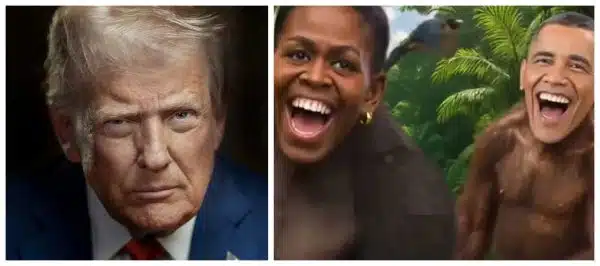
U.S. President Donald Trump briefly shared a racist video depicting former President Barack Obama and former First Lady Michelle Obama as monkeys, triggering outrage across the political spectrum before the post was deleted in an unusual reversal by the White House.
The video appeared late Thursday night on Trump’s Truth Social account and was removed roughly 12 hours later. Initially, the White House dismissed the criticism as “fake outrage,” but later acknowledged that a staff member had made the post in error.
“A White House staffer erroneously made the post. It has been taken down,” a White House official told AFP.
The roughly one-minute video promoted conspiracy theories about Trump’s 2020 election loss to Joe Biden and included a brief clip in which the Obamas’ faces were superimposed on monkeys, set to the song “The Lion Sleeps Tonight.” It also repeated false claims about Dominion Voting Systems.
Before admitting the error, White House Press Secretary Karoline Leavitt had characterized the footage as an internet meme and urged critics to “stop the fake outrage.” The subsequent walk-back marked a rare concession by an administration that typically resists acknowledging mistakes.
Democrats condemned the post swiftly. House Minority Leader Hakeem Jeffries called Trump “vile” and urged Republicans to denounce what he described as “disgusting bigotry.”
Notably, criticism also came from Republicans. Senator Tim Scott, the only Black Republican senator, labeled the video “the most racist thing I’ve seen out of this White House” and called on Trump to remove it. Senator Roger Wicker said the post was “totally unacceptable” and urged an apology.
There was no immediate comment from the Obamas.
The incident follows a pattern of provocative posts from Trump since returning to office, including the use of hyper-realistic AI-generated content to mock critics.
Trump has a long history of antagonism toward Obama, dating back to his promotion of the false “birther” conspiracy. He has also drawn criticism from opponents for policies and rhetoric targeting diversity, equity, and inclusion (DEI) programs.
The backlash—and the eventual deletion—underscores the heightened scrutiny around racist imagery in political communications and the growing concern over the misuse of AI-generated content in public discourse.