
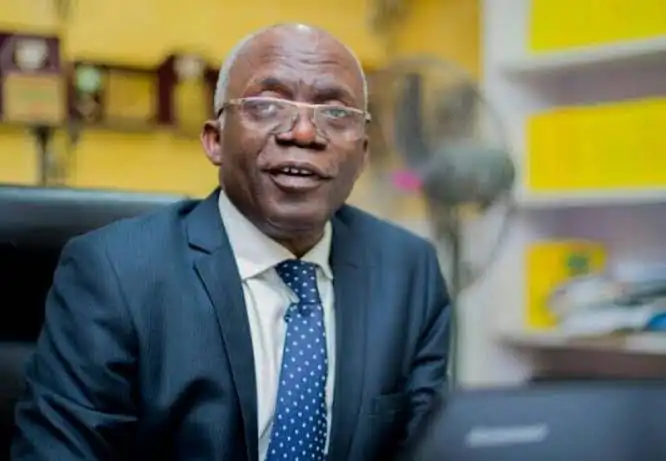
Human rights lawyer, Femi Falana, SAN, has raised serious concerns over the alleged use of expired tear gas canisters by police operatives during last week’s protest against illegal demolitions and forced evictions in the Makoko waterfront area of Lagos State.
Falana spoke at the Lagos State University Teaching Hospital (LASUTH) during a visit to protesters who sustained injuries after the demonstration, which was organised by activists Hassan Taiwo, popularly known as Soweto, and Dele Frank. The protest was aimed at drawing the attention of the Lagos State Government to alleged unlawful demolitions in waterfront communities.
Although the protest reportedly began peacefully, it later turned violent after police operatives fired tear gas at close range, leaving several protesters injured. The incident drew widespread condemnation from human rights groups and civil society organisations.
Speaking at LASUTH, Falana described the police action as unconstitutional, dangerous, and a violation of citizens’ right to peaceful assembly.
“In my over 40 years of participating in protests across the country, I have never seen tear gas canisters cause such severe injuries. The injury I have seen is not normal,” Falana said, expressing alarm at the nature of the wounds sustained by protesters.
At the hospital, Falana was briefed on the condition of one of the injured protesters, Mrs Kafayat Muftaudeen, by a burns and plastic nurse, Mr Adedeji Hassan. Hassan explained that Muftaudeen, who sustained a severe leg injury, was being discharged but would continue treatment through weekly wound dressing and hospital visits before undergoing surgery.
“She is fit to go home and will be coming to the hospital weekly for dressing,” Hassan said, adding that she would later undergo skin grafting once the wound healed.
Falana stressed that the 1999 Constitution guarantees freedom of expression and peaceful assembly, noting that Nigerians do not require police permits to protest. According to him, the Police Establishment Act only requires organisers to notify the police, who are duty-bound to provide security.
He added that the protest organisers complied with the law, as police officers had peacefully escorted the protesters from Ikeja Under Bridge to the Alausa Secretariat before the situation escalated.
Meanwhile, the Lagos State Government defended the demolition exercise in Makoko, stating that it was carried out to protect lives and prevent potential disasters. Speaking at a joint ministerial press briefing in Alausa, Ikeja, the Commissioner for Information and Strategy, Gbenga Omotoso, alongside the Governor’s Special Adviser on E-GIS and Urban Development, Dr Babatunde Olajide, and the Special Adviser on Media and Publicity, Gboyega Akosile, said the state had a responsibility to safeguard residents.
Omotoso explained that many of the demolished wooden structures were built directly beneath high-tension power cables, posing serious risks to occupants. He said the exercise was undertaken in the interest of public safety and human dignity.
Olajide added that the Oworonsoki demolition had followed over 10 years of planning, while the Makoko exercise was part of a statewide safety programme targeting high-tension corridors. He disclosed that the state had committed $2 million to the Makoko water city project and was expecting additional counterpart funding from international partners.
“I can assure that through the benevolence of Mr Governor, Makoko displaced residents will be compensated. We are already in the process of enumeration. First thing is to save lives above other considerations,” Olajide said.
He further stated that residents had been engaged on the redevelopment project and that international partners, including the United Nations, were involved in its implementation.
In a related development, the Lagos State House of Assembly has summoned stakeholders and leaders of Makoko and adjoining waterfront communities following a petition submitted by affected residents. The Clerk of the House, Olalekan Onafeko, said the meeting would hold on February 3, 2026, at the Assembly Complex in Alausa, Ikeja.
Separately, the Centre for Human and Socio-Economic Rights (CHSR) condemned the handling of the protest and called for an independent investigation into the killing of six traders in the Owode Onirin area of Lagos State in August 2025.
Speaking at the International Press Centre in Ogba, Lagos, the President of CHSR, Alex Omotehinse, said peaceful protest is a constitutional right and demanded justice, compensation, and restoration for affected communities.
“Victims of demolition are citizens, not enemies, and civil society organisations are partners in democracy, not adversaries,” Omotehinse said.