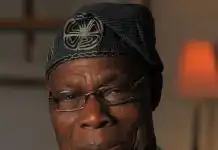

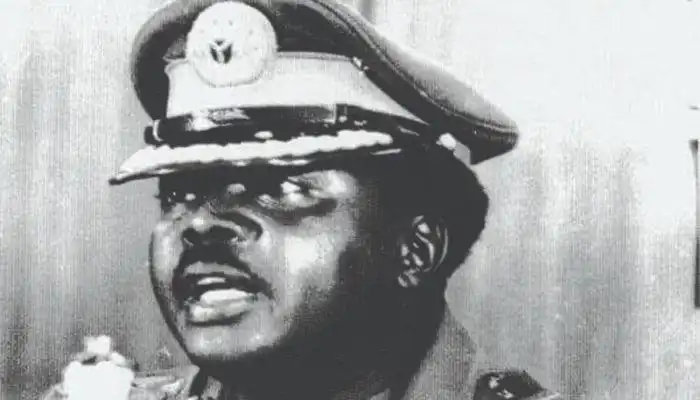
Former President Olusegun Obasanjo has offered a sobering reflection on one of Nigeria’s most defining political tragedies, saying former Head of State Murtala Muhammed may have survived if security around him had been handled differently.
Speaking during an interview on News Central TV, Obasanjo revisited the events surrounding the failed February 13, 1976 coup and argued that what happened was not simply the result of a military plot, but also a consequence of what he described as dangerous naivety within the government at the time.
His remarks have stirred fresh attention around the assassination of Murtala Muhammed, a leader often remembered for discipline, reform, and a bold vision for Nigeria, whose time in power was cut short barely six months after taking office.
“Murtala would not have been killed the way he was killed if not for our naivety,” Obasanjo said, in what many are seeing as one of his most candid reflections yet on the tragedy.
According to him, the security culture around the late Head of State was far too relaxed for the volatile political climate of that period. He recalled that Murtala often moved without heavy security and sometimes drove himself, believing he had no personal enemies because he was serving the national interest.
Obasanjo suggested that confidence, admirable as it may have seemed, created dangerous vulnerabilities.
He said he had advised tightening security, but those warnings were not fully acted on. In his telling, the leadership at the time did not seriously imagine a coordinated attack targeting the country’s leader, a miscalculation he now believes proved costly.
His comments revive long-standing debate over whether the assassination could have been prevented and whether the revolutionary simplicity associated with Murtala’s leadership unintentionally exposed him.
The issue resurfaced earlier this year when his daughter, Aisha Muhammed, also reflected on the circumstances surrounding her father’s death during an appearance on Arise News.
Marking 50 years since the incident, she described a leader who deliberately rejected the trappings of power. According to her, her father avoided large motorcades, sirens and intimidating security details, choosing instead to move among ordinary citizens in a way few leaders would dare.
That lifestyle, she acknowledged, made him vulnerable.
She recounted that he was caught in traffic in Lagos on the day of the coup when the attackers struck, a detail that has long symbolized both his accessibility and the fatal security gap around him.
Her comments and Obasanjo’s latest remarks now converge on a similar point, that Murtala Muhammed’s assassination was not only about the coup plotters, but also about a leadership philosophy that underestimated risk.
That is part of why Obasanjo’s comments matter.
They are not merely historical recollections. They reopen the conversation about leadership, state security and the tension between accessibility and protection, a question that remains relevant in Nigeria and beyond.
Murtala Muhammed came to power after the 1975 coup that removed Yakubu Gowon and quickly built a reputation for discipline and anti-corruption reforms. Though his rule lasted only months, his legacy has endured for decades.
Obasanjo’s reflections now add a deeply personal layer to that legacy, suggesting that history may have unfolded differently had simple security decisions been made another way.
And decades later, the haunting question still lingers, whether one of Nigeria’s most consequential assassinations could have been avoided.