

President Bola Ahmed Tinubu has defended his administration’s controversial decision to remove fuel subsidies, arguing that the policy saved Nigeria from a looming fiscal crisis and laid the foundation for economic recovery.
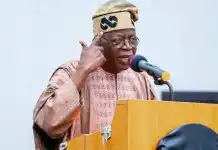
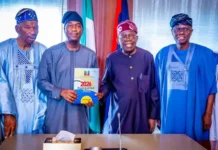
Speaking on Tuesday while receiving state governors who visited him to mark the Eid al-Kabir celebration and the third anniversary of his administration, the President said the difficult reforms introduced shortly after he assumed office were necessary to prevent the country from sliding into bankruptcy.
Tinubu acknowledged that the subsidy removal triggered hardship for millions of Nigerians, leading to higher transportation costs, inflationary pressures, and widespread criticism. However, he maintained that continuing the subsidy regime would have placed an unbearable burden on public finances.
According to the President, successive governments spent enormous sums on fuel subsidies that disproportionately benefited a small group of individuals while limiting investments in critical sectors such as infrastructure, agriculture, healthcare, and education.
“It was challenging at the time, but we survived,” Tinubu said.
“We faced litigation and accusations. We survived them. Instead of bankruptcy, Nigeria has survived. The economy has recovered. It is growing. Agriculture is booming.”
The President made the remarks during a gathering attended by governors from several states, including Lagos State, Nasarawa State, Jigawa State, Sokoto State, Kebbi State, Taraba State, Niger State, Ekiti State, Delta State, Ondo State, Edo State, Adamawa State, Benue State, Enugu State, Ogun State, and Kogi State, as well as deputy governors from Borno and Kano states.
Highlighting what he described as signs of progress, Tinubu pointed to ongoing investments in agriculture and infrastructure, particularly along the proposed Sokoto-Badagry development corridor.
The President noted that irrigation projects, dams, power infrastructure, and farmland development along the route could significantly boost food production and economic activity across several regions.
“Today I was watching some clips of the Sokoto Badagry axis. Imagine how many dams on that corridor for irrigation, for farmland, for electricity,” he said.
Tinubu also commended state governors for supporting federal reforms despite public dissatisfaction in some quarters. According to him, their willingness to foster patience and trust among citizens has enabled the government to implement difficult policies.
“Many of you have survived and promoted the perseverance of our people, asking them to trust this government, and you have built that trust around my leadership. I thank you very much,” he added.
Since the subsidy removal in May 2023, the policy has remained one of the most debated decisions of Tinubu’s presidency.
Supporters argue that ending the subsidy was necessary to curb wasteful spending and free up resources for development projects. At the same time, critics point to the rising cost of living and the persistent economic hardship faced by many Nigerians.
Despite those concerns, the President insists that the reforms are beginning to deliver results.
His latest remarks signal that the administration remains committed to its economic agenda and believes the country is beginning to reap the benefits of decisions that were initially unpopular but, in its view, necessary for long-term stability.
As Nigeria approaches another election cycle, the debate over subsidy removal is likely to remain a central issue, with supporters and critics continuing to assess whether the promised economic gains ultimately justify the sacrifices made by citizens.