

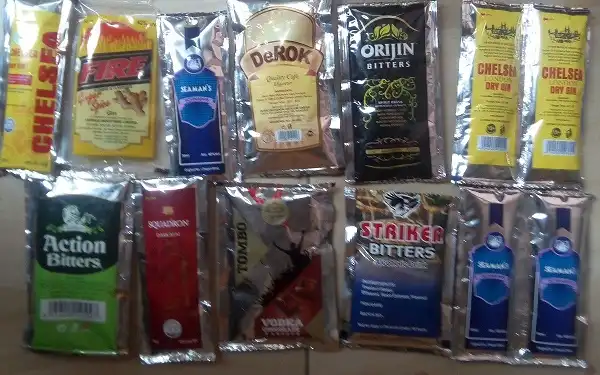
The National Agency for Food and Drug Administration and Control (NAFDAC) has prohibited the production of alcoholic drinks in sachets that are less than 200 millilitres.
According to NAFDAC, manufacturers were given a five-year period starting in 2018 to cease production of these drinks in sachets and pet bottles.
This deadline ended on January 31, 2024. The ban officially took effect on February 1, 2024, as announced by the director-general of NAFDAC, Prof. Mojisola Adeyeye.
She explained that this ban was not sudden, but rather the result of a phased approach decided upon by a multilateral committee.
The committee aimed to reduce production by 50% by 2020 and ultimately implement an outright ban by January 31, 2024.
Given that decision, the DG said NAFDAC did not issue renewal licenses exceeding January 2024 to any manufacturer of the products.
According to her, the agency took the route of wiping out the drinks in such sachets because of the negative effects on underage children.
She said because the drinks come in pocket-friendly sizes, accessible and affordable, children easily fell for the packages only to face the consequences in the future.
She said: “This decision was based on the recommendation of a high-powered committee of the Federal Ministry of Health and NAFDAC on one hand, the Federal Competition and Consumer Protection Commission (FCCPC), and the Industry represented by the Association of Food, Beverages and Tobacco Employers (AFBTE), Distillers and Blenders Association of Nigeria (DIBAN), in December 2018.
“As a commitment to the decision reached at the end of this Committee meeting, producers of alcohol in sachets and small volume agreed to reduce the production by 5 percent with effect from 31st January 2022 while ensuring the product is completely phased out in the country by 31st January 2024”.
According to her, the future of the country supersedes other considerations in the enforcement of the policy.
Noting that saving Nigerian children and protecting the health of the larger society is paramount, Adeyeye said: “The people who are mostly at risk of the negative effect of consumption of the banned pack sizes of alcoholic beverages are the under-aged and commercial vehicle drivers and riders.