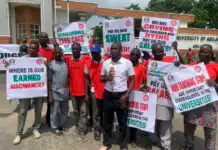


Barring any last-minute intervention, the Senior Staff Association of Nigerian Universities (SSANU) has declared its readiness to embark on an indefinite strike from October 6. The decision follows the expiration of a two-week extension given to the Federal Government regarding the renegotiation of the 2009 Agreement, which the union accuses the government of neglecting.
In a communique issued after its 52nd National Executive Council (NEC) meeting held at Alvan Ikoku Federal University of Education, Owerri, SSANU criticized the government’s alleged persistent disregard for Memoranda of Understanding (MoUs), Memoranda of Action (MoAs), and other negotiated collective agreements.
The association stressed that such agreements, reached through structured dialogue and mutual consent, remain binding and must be respected. It warned that continued neglect would leave the union with no choice but to seek all lawful avenues to ensure compliance.
Signed by its President, Comrade Mohammed Haruna Ibrahim, the communique expressed dissatisfaction over the sharing of the ₦50 billion Earned Allowance. Only ₦10 billion was allocated to the three non-teaching unions—SSANU, the Non-Academic Staff Union of Educational and Associated Institutions (NASU), and the National Association of Academic Technologists (NAAT)—despite earlier agreements that the entire ₦50 billion would be distributed before the suspension of the 2022 industrial action.
“This allocation is unjust, discriminatory, and fails to acknowledge the indispensable role SSANU members play in the effective functioning of Nigerian Universities. It is also in breach of the MoU/MoA signed with the Joint Action Committee (JAC) of NASU and SSANU in August 2022,” the union said.
The union demanded the immediate release of the remaining ₦40 billion to ensure fairness and inclusiveness across all non-teaching staff unions in line with existing agreements.
Addressing the unresolved 2009 Agreement, SSANU stated: “After extensive deliberations on national issues and the welfare of its members, the NEC expresses deep disappointment over the continued silence and inaction of the Federal Government’s Renegotiation Committee regarding the 2009 FG/SSANU Agreement. NEC strongly calls on the government to honor the two weeks extension given by JAC of SSANU/NASU in order to avert the impending industrial crisis in the university system.”
On the issue of withheld salaries, the communique added: “NEC strongly condemns the continued withholding of salaries of SSANU members who participated in the 2022 industrial action. NEC therefore, urges the Federal Government to immediately release the outstanding two (2) months withheld salaries as a demonstration of good faith and commitment to restoring industrial harmony within the University system. NEC also notes that third-party deductions from the already paid two months of withheld salaries have yet to be remitted and therefore calls for the immediate release of these funds.”
Beyond labour matters, the NEC expressed worry over the declining state of critical sectors, citing underfunding of healthcare, outdated infrastructure, and outbreaks such as the recent cholera epidemic in Zamfara and other regions.
“Widespread insecurity including kidnappings, banditry, and communal clashes continues to disrupt daily life, displace families, and cripple economic activity. Agriculture and food security are under severe threat, with an estimated 33.1 million Nigerians facing acute food shortages due to conflict, climate shocks, and economic instability,” the communique stated.
It also raised alarm over the condition of national infrastructure, pointing to incidents like the Abuja-Kaduna train derailment. “Roads remain poorly maintained, power supply unreliable, and flood disasters such as the devastation in Yola South (Adamawa State) and parts of Niger and Lagos States expose the fragility of transport and water systems.”
On education, SSANU emphasized: “NEC observes that Nigeria’s education sector, from primary to tertiary levels, suffers from inadequate funding and outdated facilities. The Council calls for modernization of learning environments, stronger support for technical and vocational training, and equitable development of both teaching and non-teaching staff through fair remuneration and continuous professional development.”