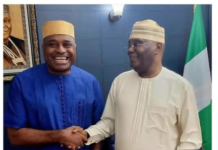


Former Minister of Aviation, Osita Chidoka, has strongly criticized threats issued against 2023 Labour Party presidential candidate Peter Obi, warning that such actions signal a dangerous return to the political intolerance and constitutional instability that marred Nigeria’s First Republic.
In a detailed statement on Wednesday, Chidoka condemned comments made by Edo State Governor Monday Okpebholo, who allegedly warned that Obi should not enter Edo State without prior approval and threatened that his security would not be guaranteed. The governor’s remarks, made on Friday, July 18, have sparked widespread outrage and rekindled fears of creeping authoritarianism.
“These threats are not only unlawful, they signal a creeping descent into regional lawlessness,” Chidoka said, describing the statement as a form of “territorial authoritarianism” by state governors.
He also referenced a similar event in April, when Benue State Governor Hyacinth Alia allegedly barred Obi from visiting Internally Displaced Persons (IDP) camps in the state.
A Grim Historical Warning
Drawing parallels with Nigeria’s troubled political past, Chidoka recalled the events of 1964, when opposition leaders like Michael Okpara of the United Progressive Grand Alliance (UPGA) were denied access to parts of the country, contributing to a constitutional crisis and the eventual military coup of 1966.
“This is how it starts,” Chidoka warned. “When parts of the country treat opposition as a threat, history has shown where that leads — instability and national breakdown.”
Chidoka also cited global precedents, including the 1957 U.S. civil rights crisis in Arkansas and India’s misuse of emergency powers, to show how unchecked local leaders can undermine democracy.
Is Nigeria’s Democracy Selective?
The former minister questioned whether Obi’s treatment would have been different if he were from another region. He pointed out that past opposition figures like President Bola Tinubu and former President Muhammadu Buhari were never restricted from campaigning across the country.
“This raises an urgent question: is Nigeria’s democratic space truly open to all citizens, or only to some?” he asked.
Chidoka reminded Nigerians that under Section 41(1) of the 1999 Constitution, every citizen has the right to move freely and reside anywhere in the country. He emphasized that governors do not have the legal authority to restrict movement or issue security threats.
“Governor Okpebholo’s statement is not just political theatre, it is unlawful intimidation and a blatant violation of constitutional rights,” he added.
A Call for Legal Action and Institutional Clarity
Chidoka urged Peter Obi to respond assertively and lawfully by:
-
Visiting Edo State as planned.
-
Formally notifying the Inspector General of Police and Director General of the DSS.
-
Seeking a declaratory judgment from the Federal High Court affirming his constitutional right to freedom of movement.
He also encouraged key institutions, including the National Human Rights Commission, Nigeria Police Force, and the Presidency, to publicly affirm that no Nigerian needs permission from a governor to travel within the country.
Chidoka further demanded that Governor Okpebholo issue a public apology and retraction for his comments.
Upholding Democracy Ahead of 2027
As the 2027 general elections draw closer, Chidoka warned political leaders not to repeat the mistakes of the past, stressing that democratic principles and the rule of law must be upheld.
“Nigeria must not relive the trauma of 1964. The rule of law must prevail, and no citizen should require permission to be Nigerian,” he concluded.