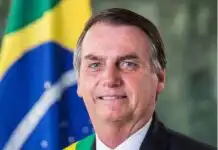


A Brazilian Supreme Court judge has placed former president Jair Bolsonaro under house arrest, accusing him of breaching a court-imposed social media ban during his ongoing trial over an alleged coup plot following his 2022 election defeat.
The decision by Justice Alexandre de Moraes intensifies the standoff between Brazil’s judiciary and the controversial right-wing ex-leader, who stands accused of conspiring with allies to cling to power after losing to current president Luiz Inácio Lula da Silva.
De Moraes, who is presiding over the high-profile case, cited Bolsonaro’s “repeated failure” to comply with judicial orders. The former president had been banned from using social media or having third parties distribute his public statements during the trial.
Despite this, Bolsonaro appeared in a video call with his son, Senator Flavio Bolsonaro, during a pro-Bolsonaro rally in Rio de Janeiro on Sunday. The footage, widely shared by supporters online, was deemed a direct breach of the court’s restrictions.
In response, De Moraes said the judiciary “would not allow a defendant to treat it like a fool” simply because of “political and economic power.” The court ordered Bolsonaro to be placed under house arrest at his home in Brasília. He is now barred from receiving any visitors apart from his lawyers and prohibited from using mobile phones. Authorities confirmed that multiple phones were seized from his residence.
The 70-year-old, who led Brazil from 2019 to 2022, was already under strict pre-trial conditions. These included wearing an electronic ankle monitor and observing a nightly and weekend curfew.
The move sparked sharp criticism from the United States. The State Department’s Bureau of Western Hemisphere Affairs posted on X: “Minister Alexandre de Moraes, already sanctioned by the United States for human rights violations, continues to use Brazilian institutions to silence the opposition and threaten democracy. Let Bolsonaro speak!”
That message was amplified by Bolsonaro’s son, Congressman Eduardo Bolsonaro, who has long urged Washington to take action against the Brazilian judiciary. “Brazil is no longer a democracy,” he wrote, calling Justice Moraes an “out-of-control psychopath.”
Under President Donald Trump, who returned to office in 2024, the U.S. has sanctioned Moraes, barring him from entering the country and freezing his American assets. Despite the backlash, Moraes has cast himself as a guardian of Brazilian democracy, warning of the dangers posed by rising far-right extremism.
Bolsonaro’s legal woes are tied to an alleged plot involving seven co-defendants aimed at overturning the 2022 election results. Prosecutors claim the plan failed only because the military refused to intervene. If convicted, Bolsonaro faces up to 40 years in prison. The trial is expected to wrap up within weeks.
After Lula’s inauguration in January 2023, Bolsonaro supporters stormed the Brazilian Congress, clashing with police and destroying legislative property—an incident widely compared to the January 6 Capitol riot in the United States.
Though currently banned from holding political office, Bolsonaro is reportedly eyeing a political comeback in 2026, echoing former U.S. President Trump’s return. His core conservative base remains enthusiastic, as seen in recent rallies in Rio, São Paulo, and Brasília—some featuring American flags and signs reading “Thank you Trump.”
President Lula, now 79, has hinted at a possible re-election bid in 2026, health permitting. He was hospitalized last year after suffering a brain hemorrhage caused by a fall.