
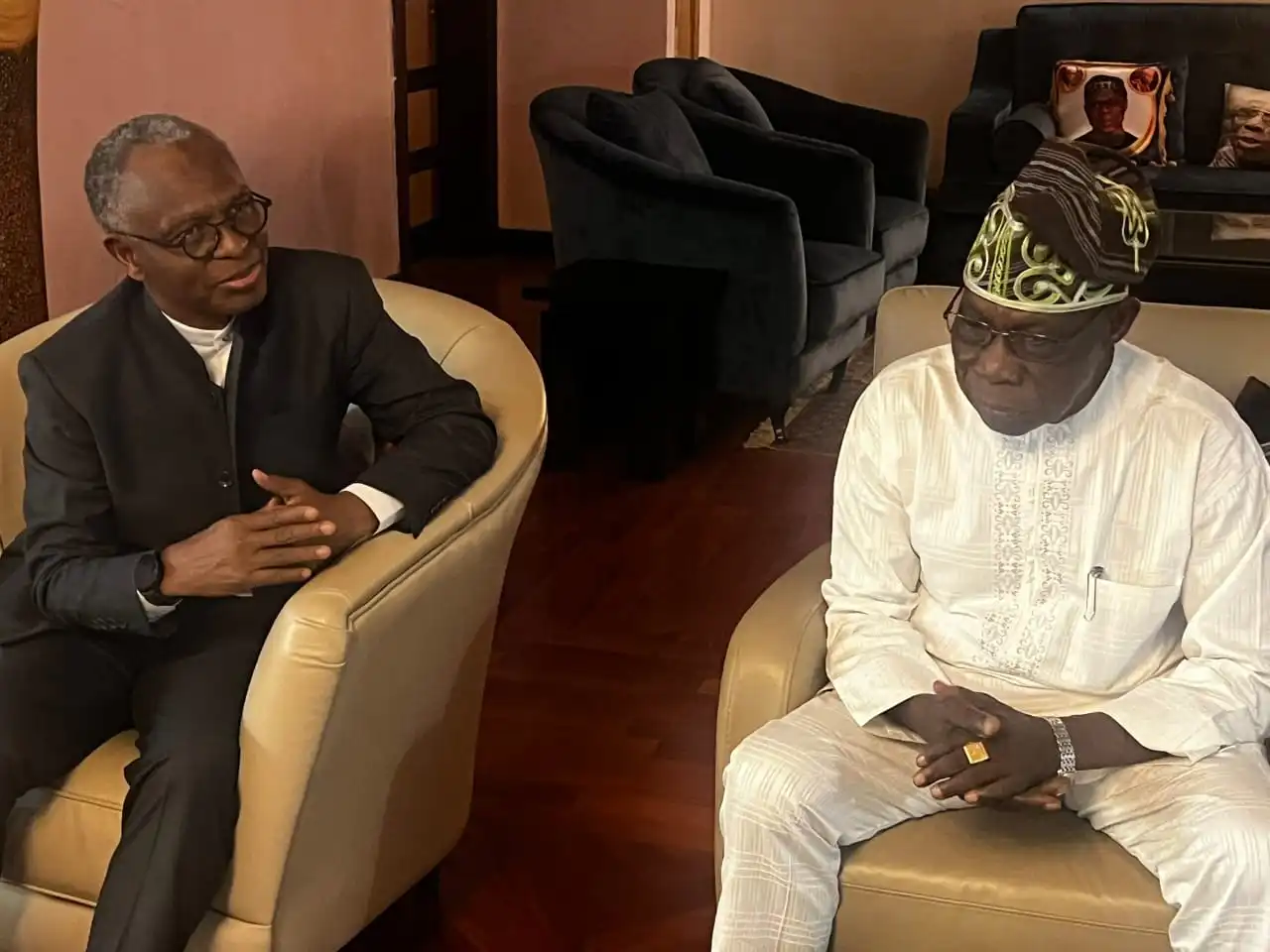
Former President Olusegun Obasanjo has disclosed that he turned down a proposal to appoint former Kaduna State Governor, Nasir El-Rufai, as his successor in 2007, citing the latter’s “lack of maturity” at the time.
Obasanjo made the revelation on Friday, October 24, in Abeokuta, Ogun State, during the second edition of the Ajibosin Platform Annual Symposium, themed “Importance of Leadership in Governance.”
According to the former president, the idea was first suggested by former Minister of Aviation, Osita Chidoka, who had recommended El-Rufai as a capable replacement. El-Rufai had served under Obasanjo’s administration as Director-General of the Bureau of Public Enterprises (BPE) before being appointed Minister of the Federal Capital Territory (FCT) between 2003 and 2007.
Recounting the conversation in a humorous tone, Obasanjo said,
“He was pushing when I was leaving government that his friend, El-Rufai, should be brought in as my successor.”
Turning to Chidoka, who was seated among the panelists, Obasanjo asked, “No be so?” to which Chidoka responded with a nod.
Obasanjo continued,
“I did not yield to the pressure. Later, he said, ‘I suggested this person, why didn’t you agree?’ I said El-Rufai needed to mature. Years later, after seeing his performance, he came back to me and said, ‘You’re absolutely correct. El-Rufai needed to mature.’”
While noting that he did not endorse El-Rufai at the time, Obasanjo expressed admiration for both El-Rufai and Chidoka, describing them as men with “special attributes” who made valuable contributions to his administration.
Speaking on leadership, Obasanjo emphasized that true leadership requires character, experience, exposure, and proper training.
“It’s only in politics that I discovered there’s no training for leadership,” he said. “Even among armed robbers, I was told there is apprenticeship. But it’s only in politics that there’s no training. That’s not good enough.”
Delivering the keynote address, Osita Chidoka argued that Nigeria’s problems are rooted in what he called “the politics of alibi” — a culture where excuses replace accountability.
“Leadership finds its true measure not in charisma but in the systems it leaves behind. Nigeria’s problem has never been a shortage of ideas; it is the absence of systems strong enough to outlive their authors,” he said.
Chidoka urged leaders to move from rhetoric to measurable results by strengthening institutional accountability and monitoring systems.
The event’s convener, Aare Olanrewaju Bakinson, said the symposium was designed to promote discussions on ethical and visionary leadership.
“Leadership is not just about power; it’s about responsibility, vision, and service,” he noted.
Notable attendees included Senator Shuaibu Salis (Ogun Central), the Olowu of Owu Kingdom, Oba Saka Matemilola, the Olota of Ota, Oba Adeyemi Obalanlege, and former Ogun State First Lady, Mrs. Olufunsho Amosun.