


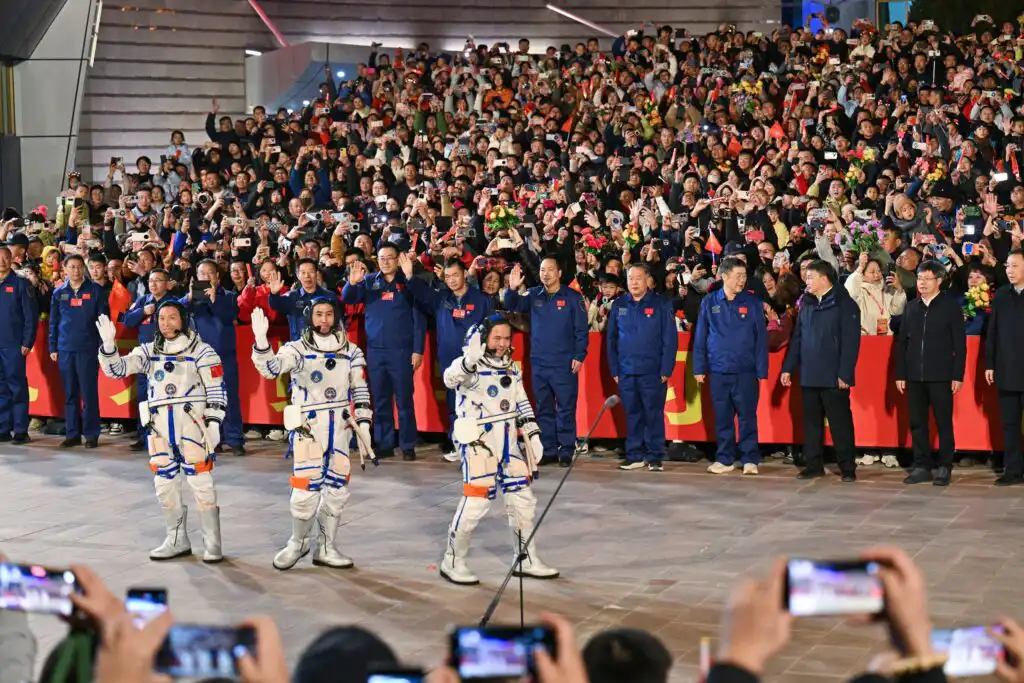
A crew of three Chinese astronauts — including the nation’s youngest ever — successfully docked with the Tiangong space station early Saturday, November 1, accompanied by an unusual group of passengers: four lab mice.
According to Xinhua News Agency, the Shenzhou-21 spacecraft docked with Tiangong at 3:35 a.m. Saturday (1935 GMT Friday, October 31), nearly four hours after launching aboard a Long March-2F rocket from the Jiuquan Satellite Launch Center in northwest China.
The Tiangong space station, which hosts rotating three-member crews every six months, remains the centerpiece of China’s expanding space ambitions — a multibillion-dollar project designed to rival the United States and Russia in space exploration.
China’s long-term goals include sending astronauts to the Moon before 2030 and eventually establishing a lunar base, a key part of what President Xi Jinping has described as the nation’s “space dream.”
The Shenzhou-21 crew comprises Commander Zhang Lu, a seasoned space pilot; Flight Engineer Wu Fei, aged 32 and China’s youngest astronaut to embark on a mission; and Payload Specialist Zhang Hongzhang, 39.
Before liftoff, the trio waved goodbye to their families and colleagues at the Gobi Desert launch base as a military band played a patriotic anthem.
“We will report back to our motherland and its people with complete success,” Commander Zhang Lu told reporters before launch.
First-time astronaut Wu Fei expressed enthusiasm for the historic mission, saying he felt “incomparably lucky.”
Joining the astronauts are four mice — two male and two female — marking China’s first in-orbit biological experiment involving rodents. Scientists expect the research to shed light on how long-term exposure to space affects mammals.
China’s rapidly advancing space program, which became the third in history to send humans into orbit after the United States and the Soviet Union, has celebrated major achievements in recent years — including the Chang’e-4 probe’s 2019 landing on the Moon’s far side and the successful deployment of a Mars rover in 2021.
The China Manned Space Agency (CMSA) said on Thursday that it is carrying out critical preparatory tests for the 2030 Moon landing mission.
During their stay aboard Tiangong, the astronauts will conduct scientific experiments, perform spacewalks, and install anti-debris shields on the station’s exterior to protect it from orbital debris.
The mission also features a popular science education component, designed to inspire young people and strengthen international collaboration in space exploration.
Since being barred from the International Space Station (ISS) in 2011 due to U.S. restrictions on NASA’s cooperation with China, Beijing has sought new global partnerships. In February 2025, China signed an agreement with Pakistan to recruit the first foreign “taikonauts”, signaling Beijing’s intent to lead a new era of global space cooperation.