
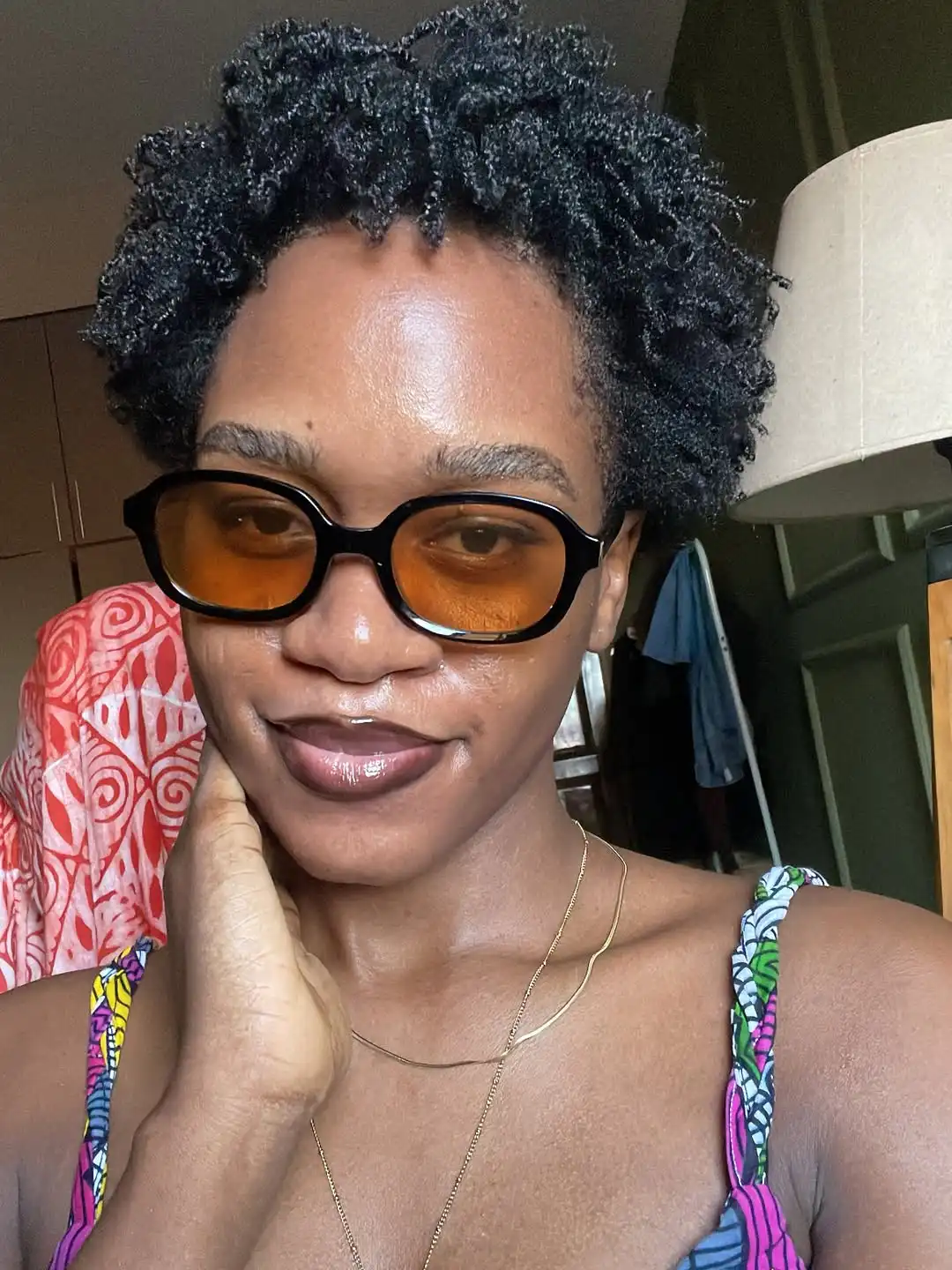
Content creator Maraji has sparked conversation online after sharing a deeply personal reflection on beauty standards, questioning why many Black women feel the need to alter or conceal their natural hair before feeling confident or beautiful.
Speaking in a video shared on social media, Maraji explained that she once struggled with similar thoughts, admitting she used to wonder why Black people seemed to be the only group expected to change their natural hair texture or keep it hidden beneath wigs and extensions.
According to her, those questions eventually pushed her to embrace and better understand her own hair.
She said:
“Why are we the only group of people who have to wear another texture of hair to feel beautiful? Why are we the only people who have to protect our hair? Like, put it in cornrows and then wear another texture of hair.
“Like, why did God decide that Black people would not have good hair? That was a thought. That was a mentality that was in my head.
“That made me want to know my hair. That made me want to understand my hair. So I started wearing my hair.
“I started putting it in a bun. It was really short, but I just wanted to wear my hair. I was washing it as much as I could, and then I started to enjoy my hair.”
“The Idea of ‘Protective Styles’ Started to Bother Me”
Maraji said her journey toward embracing her natural hair also changed the way she viewed the concept of protective styles.
While stressing that she appreciates traditional hairstyles such as cornrows, all-back and shuku, she questioned the belief that Black hair must constantly be “protected” by keeping it hidden for long periods.
She said:
“And that was when I started hating the idea of protective styles. Genuinely. Every time I hear that phrase, it annoys me.
“It really does. I understand that you might want to put your hair in cornrows. Cornrows are beautiful. All-back is fine. Shuku is nice. Those are beautiful, elegant hairstyles.
“But the idea that we are constantly protecting the hair annoys me because no other group of people keeps their hair locked away 12 months a year. The idea that they are protecting it. From what?”
She also argued that many African women naturally have fine hair, making the frequent use of heavy extensions a practice worth reconsidering.
“Most Africans have the thinnest hair. We cannot afford to be wearing the kind of attachments we are wearing. But we are the ones who do the most when it comes to our hair.”
“People Asked If I Was Deeper Life”
Reflecting on one memorable experience, Maraji recalled appearing on Rubbin’ Minds with her hair packed into a bun and topped with a faux afro.
Rather than focusing on the interview itself, she said many people immediately associated her hairstyle with religion.
“Years back, this was when I went for my interview with Ebuka on Rubbin’ Minds. Because that day I packed my hair and put on a fake afro bun, people were like, ‘Is she Deeper Life?’ I’m Deeper Life because I want my natural hair?”
For Maraji, the reaction highlighted how quickly people attach assumptions to Black women who choose to wear their natural hair.
“Rich Women Wear Their Own Hair”
The content creator also challenged the idea that expensive wigs are a symbol of wealth or status.
She noted that many affluent women she has met, particularly in Ghana, confidently wear their natural hair, relaxed hair or locs instead of elaborate wigs.
She said:
“And what really annoys or irritates me more is when I see people who think that because they have the most expensive wigs, they talk down on people who decide to actually wear their own hair.”
Referencing the recent online discussion about a wealthy woman who wore shuku during an interview, Maraji said the public reaction revealed how deeply ingrained beauty expectations are.
She continued:
“That’s why when that billionaire lady who was recently interviewed by the white guy had shuku on her head, everybody was like, ‘Ah-ah, billionaires do shuku?’
“Here in Ghana, I meet a lot of rich women. And when I mean they never have a wig on their head, it’s always me. Me wearing a wig makes them laugh.
“I’m the one always wearing the wig, and the people I’m talking to, who have assets, lands, cars, and houses, are wearing locs. They have locs. Or they have natural hair. Or they have it in a bun. Or they have relaxed hair. Like, it is the one that grows on their scalp.
“But me, my whole head is ‘rich aunty,’ yes.”
Maraji concluded by making it clear that her message is not an attack on wigs, weaves or protective hairstyles.
Instead, she said her goal is to encourage conversations about why so many Black women still feel pressured to hide their natural hair to meet society’s expectations of beauty, professionalism, or success.
Her remarks have since sparked widespread online discussion, with many women sharing their own experiences of embracing natural hair, while others argue that wigs and protective styles remain a matter of personal preference, convenience, and self-expression rather than insecurity.