
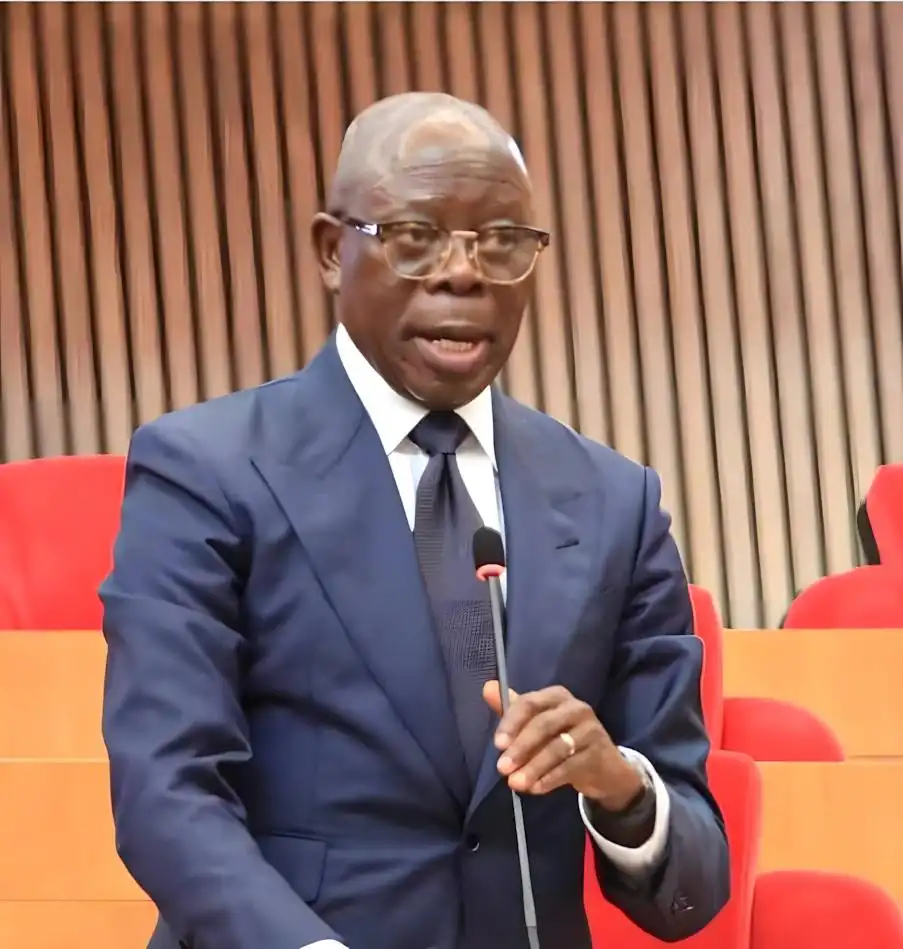
Tensions within Nigeria’s Senate have deepened as Adams Oshiomhole publicly called on Senate President Godswill Akpabio to resign, citing what he described as contradictions in the chamber’s evolving leadership rules.
Speaking during a press interview at the National Assembly, Oshiomhole challenged both the substance of the recent amendments to the Senate’s standing rules and the manner in which they are being applied.
At the center of the dispute is a new eligibility requirement for presiding officers, which he argues raises serious moral and constitutional questions.
According to him, the issue is not merely about rule-making, but about consistency.
Oshiomhole pointed out that Akpabio himself rose quickly within the Senate under existing rules, becoming a principal officer early in his legislative career. That history, he suggested, conflicts with the spirit of the newly introduced criteria.
“The Senate President became minority leader on his first day in office when he first came into the Senate,” he said, using the example to illustrate what he sees as a double standard.
His argument goes further.
Oshiomhole contends that if the proposed requirement of extended legislative experience, effectively an “eight year benchmark,” is enforced, then it should apply universally, including to the current leadership. By that logic, he believes Akpabio does not meet the threshold and should step aside to uphold fairness.
“If we pass rules that say you must do eight consecutive years before you can be Senate President, it means he has to lead by example by vacating,” he added.
The remarks introduce a broader debate about how legislative rules are shaped and applied within Nigeria’s upper chamber.
Oshiomhole also referenced past leadership structures, noting that figures like David Mark served uninterrupted terms under earlier frameworks. He questioned why changes are now being introduced in a way that could limit access to leadership positions.
For him, the concern is not just procedural but democratic.
He warned that reforms perceived as selective or restrictive could weaken internal competition and undermine confidence in the institution. In his view, rules should be designed to strengthen governance, not narrow participation.
The clash highlights an increasingly visible fault line within the Senate, where procedural decisions are intersecting with political ambition and institutional authority.
While Akpabio has not publicly responded to the latest remarks, the issue adds to ongoing tensions within the chamber following recent debates over rule enforcement and leadership structure.
At its core, the controversy reflects a familiar challenge in legislative systems: balancing reform with fairness.
As discussions continue, the focus will likely remain on whether the Senate can reconcile these differences without further escalating internal divisions. For now, Oshiomhole’s position is clear: if the rules are to stand, he believes they must apply to everyone, starting from the top.