

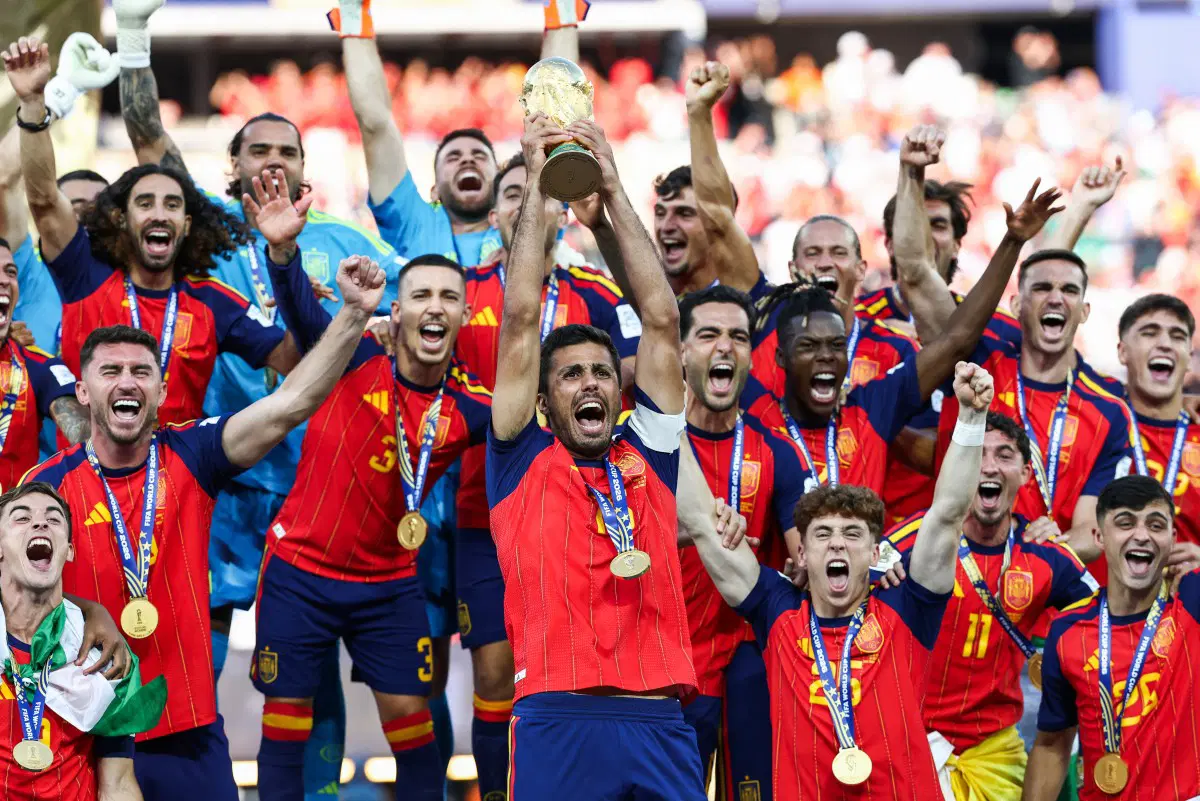
A dramatic extra-time winner from substitute Ferran Torres ended Argentina’s reign as FIFA World Cup holders, sealing a hard-fought 1-0 victory and handing Spain their second world title in a tense final at the New York New Jersey Stadium on Sunday.
For more than 100 minutes, the final looked destined for penalties as Spain dominated possession and created the better chances, but were repeatedly frustrated by Argentina goalkeeper Emiliano Martínez and a resilient defensive display.
Luis de la Fuente’s side controlled the tempo from the opening whistle, moving the ball with patience and precision while limiting Argentina to very few attacking opportunities.
Yet despite their superiority, Spain struggled to find the finishing touch against the defending champions, who were determined to protect their crown.
Martínez produced several crucial saves to keep Argentina in the contest, denying Spain on multiple occasions and once again proving why he is regarded as one of the world’s finest goalkeepers in high-pressure matches.
The game’s turning point arrived deep into second-half stoppage time.
Argentina were reduced to 10 men after midfielder Enzo Fernández received a second yellow card for a reckless challenge on teenage defender Pau Cubarsí, leaving Lionel Scaloni’s side with an uphill battle heading into extra time.
With the numerical advantage, Spain continued to pin Argentina deep inside their own half, patiently searching for the breakthrough that had eluded them throughout normal time.
Their persistence finally paid off in the 106th minute.
After excellent work down the flank, Nico Williams kept the move alive with an intelligent knock-back inside the penalty area, allowing Ferran Torres to react quickest and fire past Martínez from close range. The finish sparked wild celebrations among the Spanish players and supporters, as Torres etched his name into World Cup history with the decisive goal.
Spain’s triumph capped an outstanding tournament in which they established themselves as the competition’s most complete team.
The European champions conceded just one goal in seven matches, combining disciplined defending with the slick possession-based football that has become synonymous with Luis de la Fuente’s side.
Their journey to the trophy included victories over several elite opponents, culminating in a composed display against the reigning world champions.
For Argentina, the defeat brought an end to a spirited title defence.
Lionel Messi and his teammates had shown remarkable resilience throughout the knockout stages, recovering from difficult situations to eliminate Egypt and then coming from behind to defeat England in a gripping semi-final.
Their determination once again carried them deep into the final, but playing more than half an hour with 10 men ultimately proved too much against a relentless Spanish side.
Spain’s victory also marks a historic return to the summit of world football, 16 years after lifting their first World Cup in South Africa in 2010.
With a squad blending experienced leaders and exciting young stars such as Lamine Yamal, Nico Williams and Pau Cubarsí, La Roja appear well positioned to remain a dominant force on the international stage for years to come.
For Ferran Torres, the winning goal will forever be remembered as the strike that dethroned the defending champions and delivered Spain’s long-awaited second World Cup crown.