
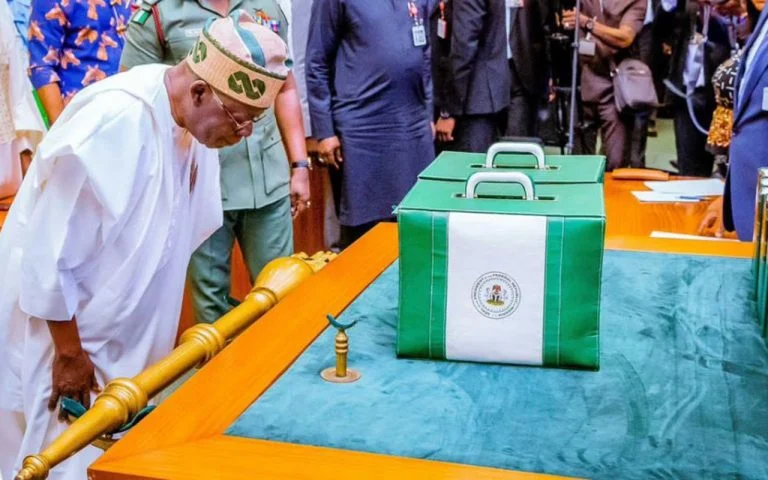
President Bola Ahmed Tinubu on Friday presented the ₦58.18 trillion 2026 Appropriation Bill to a joint session of the National Assembly, outlining a comprehensive fiscal, economic and security strategy aimed at consolidating Nigeria’s recovery and strengthening national stability.
Unveiling the proposal in Abuja, Tinubu said the 2026 spending plan is designed to deepen recent economic gains, restore investor confidence and improve the living standards of Nigerians. The budget is themed “The Budget of Consolidation, Renewed Resilience and Shared Prosperity.”
The President acknowledged the economic hardships Nigerians have endured over the past two and a half years but assured that the sacrifices are beginning to yield positive results.
He disclosed that Nigeria’s Gross Domestic Product (GDP) grew by 3.98 per cent in the third quarter of 2025, while inflation declined for eight consecutive months to 14.45 per cent in November.
He also revealed that external reserves have risen to about $47 billion, the highest level in seven years, providing cover for more than ten months of imports.
Under the 2026 budget framework, total revenue is projected at ₦34.33 trillion, with total expenditure estimated at ₦58.18 trillion.
Debt servicing is expected to consume ₦15.52 trillion, while non-debt recurrent expenditure stands at ₦15.25 trillion. Capital expenditure is pegged at ₦26.08 trillion. The budget deficit of ₦23.85 trillion represents 4.28 per cent of GDP.
Key fiscal assumptions include a benchmark crude oil price of $64.85 per barrel, daily oil production of 1.84 million barrels, and an exchange rate of ₦1,400 to the dollar.
Security received the largest allocation of ₦5.41 trillion, reflecting the administration’s renewed focus on tackling insecurity.
Infrastructure accounts for ₦3.56 trillion, education for ₦3.52 trillion, and health for ₦2.48 trillion.
Tinubu warned that the government would adopt a tougher stance on security, declaring that all armed groups operating outside the authority of the state—including bandits, kidnappers, militias, violent cults and their sponsors—would be designated as terrorists and dealt with decisively.
The President also pledged stricter budget implementation in 2026, directing ministries, departments and government-owned enterprises to meet revenue targets and eliminate leakages through full digitisation of government processes.
Highlighting social sector investments, Tinubu said more than 418,000 students have already benefited from the federal education loan scheme, while reforms in agriculture will focus on mechanisation, irrigation and food security.
He urged members of the National Assembly to support the budget, stressing that close cooperation between the executive and legislature is critical to achieving the objectives of the Renewed Hope Agenda.
“The true value of a budget is not in its announcement, but in its delivery,” Tinubu said as he formally laid the 2026 Appropriation Bill before lawmakers.