

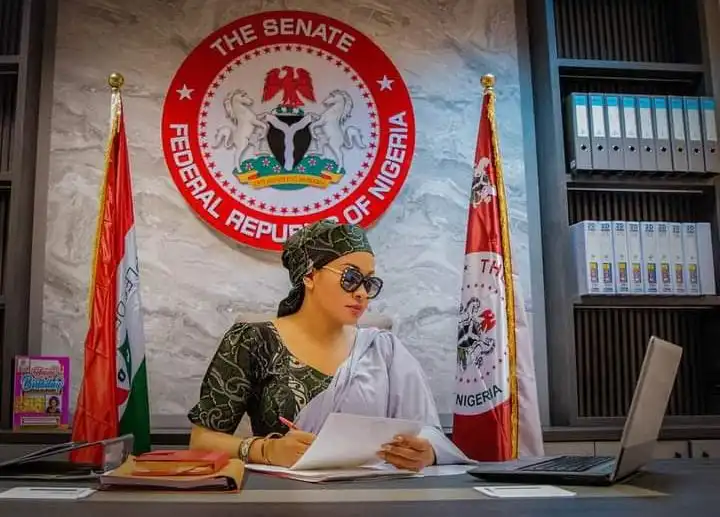
An Abuja Federal High Court has promulgated an interim injunction preventing the Senate Ethics Committee from advancing with its proposed inquiry into the conduct of Senator Natasha Akpoti-Uduaghan, thereby effectively suspending the committee’s deliberations.
The court, under the aegis of Justice Obiora Egwuatu, issued the injunction on Tuesday subsequent to an ex parte motion lodged by legal representatives of Natasha Akpoti-Uduaghan, the senator for Kogi Central.
This judicial pronouncement arises as the committee was poised to assemble and potentially enact an indefinite suspension against the senator.
The interim injunction ceases all proceedings pertaining to the matter pending additional judicial examination.
Interpreting this action as an endeavor to undermine her visibility and suppress her contributions, she declined to occupy the newly assigned seat.
Chief Whip Tahir Monguno invoked Senate regulations to rationalize the reassignment, elucidating that such modifications were imperative due to fluctuations in party affiliations among senators.
Notwithstanding this, Natasha Akpoti-Uduaghan maintained her position, culminating in a contentious exchange with Senate President Akpabio, who instructed the sergeant-at-arms to enforce the seating arrangement.
Following the dispute regarding the seating configuration, the Senate reached a unanimous decision to refer Senator Akpoti-Uduaghan to the Committee on Ethics, Privileges, and Public Petitions for a disciplinary assessment.
The committee, overseen by Senator Neda Imaseun, was mandated to present its findings within a fortnight.
Subsequently, Senator Natasha Akpoti-Uduaghan instituted a N100 billion defamation lawsuit against Senate President Akpabio and his aide, Mfon Patrick. The legal action contended that a Facebook post authored by Patrick at the behest of Akpabio contained defamatory assertions regarding her, including remarks on her legislative efficacy and personal aesthetics.
The lawsuit seeks compensatory damages and a public retraction, asserting that the publication adversely affected her reputation and exposed her to public derision.